The Body Adjustment

The Body Adjustment

JWCCO Logo

The Body Adjustment

As an Introduction to our Body Adjustment Course commencing in January 2017, we draw your attention to the article written by
John Wernham in his Lectures on Osteopathy (Volume I) on the importance of The Body Adjustment……..

“With the exception of treatment given in the case of acute disease and other certain conditions, osteopathic techniques were always applied under the aegis of the General Treatment.  There has been a total rebuttal of this first great principle in osteopathy and operators are content to give only local treatment directed to the painful area indicated by the patient.  Such a limited viewpoint represents the absolute negation of the second great principle, namely, the integration of all parts of the body, anatomically, mechanically and physiologically.  This is a broad canvas, and if there is detail it must be made to bear a right relationship with the unit body if the condition is to be resolved and the patient stabilized.

The term ‘general treatment’ fell into disrepute and soon became a background for the so-called ‘specific’, or ‘replacement’, techniques, which are entirely anatomical in concept and have no concern with the body mechanics, or function.  To give a treatment called ‘general’ gave rise to boredom and led to scant attention to the finer point of our manipulative procedures.  It was for these reasons that the old title was abandoned and the new term ‘Body Adjustment’ substituted.

The truth is that the general treatment, body adjustment, full treatment; or whatever name is chosen is the very fabric of our manipulation and demands our closest attention every step of the way.  The technique employs the long lever and deals with ALL tissues conjointly with only special emphasis where it is necessary. The method is deliberately routine in order to ensure that nothing is missed in diagnosis and, further, to establish the lost rhythm so often lacking in the patient. The limb leverage is powerful and brings into play every muscular insertion into the spine and into the pelvis, yet the effect is gentle, smooth and relaxing.  The objective is the restoration of the internal environment and thus provides those conditions essential for the recovery of the lesion state.  Without such preparation the good effect of spinal correction is limited and short-lived; in fact in a great many cases the general body adjustment will be enough for nature to make the recovery without any local, or specific, work whatsoever.  But, perhaps the most important aspect, and the most important argument in support of this traditional technique is to be found in the long-term effects which are stable and stress resistant.  Finally, it must be said that although the technique is loosely and freely given, it must be precise and accurate in execution.”
JOHN WERNHAM

To read more about “Attending our Body Adjustment Course in January 2017” you can reserve your place and find further information here: http://www.johnwernhamclassicalosteopathy.com/postgraduate-studies-on-classical-osteopathy/


Notes on Dr. J.M. Littlejohn’s Principles of Osteopathy

Notes on Dr. J.M. Littlejohn’s Principles of Osteopathy

Notes on the Principles of Osteopathy Front

Notes on Dr. J.M. Littlejohn’s Principles of Osteopathy

JWCCO is pleased to announce the launch of its new website www.jwccolearning.org.uk
By registering on this website you will be able to read this publication (Notes on the Principles of Osteopathy) and other publications free of charge.

Notes on Dr. J.M. Littlejohn’s Principles of Osteopathy, John Martin Littlejohn writes: “In discussing the theory of the treatment of disease we must differentiate between the condition of disease and the state of disease.  If treatment is to be successful it must be based on the relation of cause and effect and the diagnosis must cover every aspect and sequence of that relationship.  We deal with vitality as the sum total of all the activities of the body, and we distinguish between health that is vital and that which is merely nutritive.  Here are included:  (1) The supply of materials on a nutritive basis; (2) the power of reception and rejection of the proximate principles so provided, and (3) the power of assimilation to its own substance after the body has received, digested and absorbed the food materials.  In vital health, however, we have to consider: (4) the adjustment of all the different parts of the body on a structural basis, and (5) the adjustment of all the functional activities of the body on the basis of vitality.

“Vital unhealth as distinguished from vital health means that some impairment or deficiency is present in any one or more of these five points.  This disturbing element is expressed in the term ‘Osteopathic Lesion’ which, in its widest sense, may have its origin in the food supply; in the power to receive or assimilate and in the structural or functional activities of the body.  Disease is an effect and not a cause.  It is an effect from the disturbed vital health and the state that we call disease is always a result of a previous condition of un-health.  If we take disease as a starting point and attempt to trace it backwards, there are three topics which emerge for discussion, namely, the Etiology, Symptomatology, and the Effects, or results of disease.”

In the Notes on Principles of Osteopathy, Dr. John Martin Littlejohn further writes about the Principles of Treatment where he states that…..“Osteopathic work is palliative or curative.  Palliative treatment aims at the mitigation of pain, or the relief of some inflammatory condition, exudation, accumulation, etc.  It is accomplished mainly by the relaxation of muscular contractures and through the sensory nerve connections.  The curative work is corrective of irritability, having a three-fold object in view.  All treatment is, or ought to be, directed to the vital force through the property of the irritability of tissue, of which nerve tissue is the most highly irritable.  Every lesion involves some modification in the irritability so that the principles and practice of treatment should appeal to the irritability or to the vital force through the irritability.  In appealing to the irritability we first correct the condition of the muscles, bones, ligaments, nerves, blood vessels and so on in order to alter, or modify the irritability.  Secondly, hyper-irritability at a particular local point is lessened by inhibitory pressure over that point.  The inhibition equalises the impulses of their irritability and distribute them equally among all the different parts of the body, using the vital force as the governing principle of the distribution.  Similarly, equal distribution may be obtained by a moving pressure to stimulate when the irritability is sub-normal.  The curative work appeals more largely to the motor or efferent side of the nervous system. While the palliative work is valuable to check pain and inhibit the excessively stimulated processes which are tending to the pathological condition, the curative work employs the three methods described to restore the adjustment, coordination and cooperation of the structures and tissues through the efferent side of the nervous system.  The corrective appeals to the body as an animated mechanism based on physiological mechanics.”

To read more of “Notes on Dr. J.M. Littlejohn’s Principles of Osteopathy” you can purchase a copy from the JWCCO Bookshop for £10.00 here: http://www.johnwernhamclassicalosteopathy.com/notes-on-dr-j-m-littlejohns-principles-of-osteopathy-centenary-edition/

Applied Anatomy

Applied Anatomy

Applied Anatomy

In Dr. Marion Clark’s Applied Anatomy, the Editor, John Wernham, writes: “Clark’s Applied Anatomy was well known to the former generations of osteopaths for whom it was a standard text.  Written by an osteopath for osteopaths it highlights those aspects of the human anatomy that are of greater importance in our clinical practice.

First published in 1906, the book, now more than 100 years old, was quite unknown to British osteopaths.  Therefore it was considered that the time had come to repair this omission in our teaching programme and prepare a new edition of this most valuable work and was first published in 1986 by the Maidstone College of Osteopathy.  This is now exhausted and a third edition is hereby published.

The third edition, as was its predecessor, is dedicated to all those early pioneers who have laboured in the establishment of Osteopathy and who built the foundations upon which our present development is sustained.”

In the Preface to Applied Anatomy, Dr. Marion Edward Clark opens with the comment  “Realizing the close relation existing between anatomy and osteopathic therapeutics, that the science is built on anatomical and physiological knowed, I in 1901 outlined a course in a subject that I chose to call “Applied Anatomy”. This book is the outgrowth of that attempt to anatomically explain the signs, cause and treatment of disease.”

In the Introduction of Applied Anatomy Dr. Marion Edward Clark writes that “Disease, in the average case, is due to disturbance of structure.  Even in cases of disease resulting from abuse, there is often found some structural change.  In all diseases, whether from abuse or other causes, there are to be found structural changes, peculiar to the disease.  These structural changes, are in a general way, called lesions.  Lesions, therefore, may be muscular, ligamentous or bony.”

To read more of “Applied Anatomy” you can purchase a copy from the JWCCO Bookshop for £40 here: http://www.johnwernhamclassicalosteopathy.com/applied-anatomy/


Lesionology

Lesionology

Leisonology

Lesionology

Dr. John Martin Littlejohn’s lectures on Lesionology include: The Cervical Region; The Dorsal Region; Vertebral Lesion in the Neoplasms; The Tenth Dorsal Region; The Ninth Dorsal Region; Bone Lesions and Infectious Diseases.

J.M. Littlejohn states in the book entitled Lesionology that “The osteopathic lesion is not to be regarded as a malformation, or even a maladjustment of structures, but should be defined in terms of mobility.  That is to say, the lesion is a physiological and not an anatomical condition.  It is a modification of the movements of extension, flexion, rotation and sidebending as an isolated change, or an abnormal and artificial group movement.

In the lesion field, the involuntary movements are chiefly at fault, and the technique of diagnosis and treatment is to be discussed from the point of view of mobility, locally and generally.  The physiological movements for the purposes of adjustment are represented by the normal movements of the body trunk, the extremities, and parts of these in so far as they are unified in the body activity. Therefore the central factor to be considered is the gravity centre and the gravity lines of the body, all movements being around some axis in relation to these central lines, or points.

The movements are in circles, or modifications of circles.  The foundation of the body and its equilibrium of movement is found in the pelvis, which represents a circle, or its modification.  These movements are all in relation to the sacro-iliac articulations, the fifth lumbar and the sacral articulation on either side of the pelvis.  Also the sacro-coccygeal articulation as a unit of the gravity line movement and the triangles of the body trunk.  Lastly the femoral articulations in relation to the innominates, forming the angles of the basal triangles of support, and foundation for the trunk and the extremities.”

J.M. Littlejohn states further:  “In the acute lesion the synovial membrane shows a slight redness and the amount of synovial fluid is increased, while on the lymphatic side there is some oedema of the membrane.  In the chronic state the membrane is irregular and thickened on one side.  Post mortem there is often found a small pad of fatty material left by the disturbance of the articular relations, and derived from the synovial membrane with which the surfaces are continuous.  The pad of fat is larger where the articulation has been disturbed by strain – as in the sprained ankle.

In the early stages of the lesion condition, the most noticeable effect is that of oedema.  In the second stage there is fibrosis of the ligaments, especially the capsular ligament, followed by changes in the tendons of the muscles that move the joints with a resultant stiffening, or rigidity.  At this stage there is swelling of the periosteum over the articular processes and around the insertions of the tendons.  The joints are painful on movement and mark the beginning of the immobility which leads to the arthritic articulation.  The swelling is hard, especially on the side of the strain, indicating capsular ligament involvement, and corresponding to that side to which the spinous process is rotated.”

J.M. Littlejohn also comments that: “Frequently, an apparent lesion is a compensatory change and, in the case of vertebral immobility we find hypermobility in the neighbouring joints, which is a natural attempt to compensate for the effects of the rigidity.  The hypermobile condition is due to: (1) Weakness in tension of the supporting cartilage, ligament or muscle.  The lost tone should be re‑established and the rigid vertebrae corrected by simple articulation from the hypermobile to the rigid area, (2) An oedematous condition of the discs, caused by acidosis which should be dealt with dietetically, together with persistent traction-extension.  Simple articulation of the vertebrae towards the area of rigidity will correct.  (3) In some cases the group in which the lesion is present may be normal, but outside the group compensation may exist in the form of rigidity, swelling etc.  Although the vertebral lesion is individual, the treatment is for the group and in the arch relation.  Note that 7C and 9D are the key vertebrae in problems of group lesioning, the articulation moving from the key to the lesion field.  (4) The passive movement of an articulation.  If the lesion is recent, the mobility is increased, the elasticity of the joint muscles and the tonicity of adjacent muscles being diminished, resulting in an imbalance between the hard and soft tissues and laying the foundation for oedema.  In the treatment first attention must be given to the tonicity and elasticity before correction is attempted.  Begin by stretching the soft tissues in relation to rotation of the arm down to 8D and flexion and rotation of the leg from 5L to 9D.  Follow with spinal articulation towards the lesion.”


To read more of “Lesionology” you can purchase a copy from the JWCCO Bookshop for £10.00 here:http://www.johnwernhamclassicalosteopathy.com/dr-j-m-littlejohns-lectures-on-lesionology/

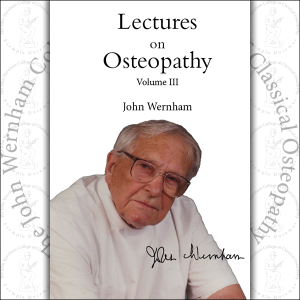
Lectures on Osteopathy Volume 3

Lectures on Osteopathy Volume 3

Lectures in Osteopathy Volume 3

LECTURES IN OSTEOPATHY VOLUME 3

In the Preface to Lectures on Osteopathy Volume 3, John Wernham is quoted as saying “Classical Osteopathy has its foundation in the work of our Founders, supported by a hundred years of research and clinical evidence, and from which there is no reason to deviate. We continue to look forward with our contribution to the art of healing intact and well-informed for the future generations of osteopathic practitioners.”

In the opening Chapter of Lectures on Osteopathy Volume 3 on Osteopathic Principles, John Wernham says “I think the first thing you must understand is that Osteopathy is not a replacement technique. Bones are never OUT and they never go IN. Noises are meaningless. Cracking joints is a game played by practitioners who should know better and the patient is deceived into thinking that the problem is solved and the disease is no more.

What we call, or used to call, the ‘osteopathic lesion’ is something a good deal more than the rather limited title employed nowadays, “somatic dysfunction,” the latter description beginning with soma simply refers to the body as distinct from the mind; it refers only to the axial body, excluding the arms and the legs. It also means, if we accept the title, that osteopathy is limited to conditions of an entirely physical nature without any kind of reference to matters of unhealthy or disease.

The older term, on the other hand, is much concerned with the relationship that we know to exist between the trunk and the prolongations known as extremities. In addition, we are also familiar with a potential in our techniques that is capable of dealing with the problems of ill-health and which far transcends the limitation of a purely physical approach to the patient.

In other words, the osteopathic lesion is a physiological lesion and is not primarily concerned with the physical structures, the disturbance being only manifest through the physical structures. Therefore, we see at once that merely to make “corrections” in the body structure without reference to any functional disorder is an absurdity. It means that the osteopathy is reduced to manipulation and its true power is lost.

To read more of “Lectures On Osteopathy Volume 3” you can purchase a copy from the JWCCO Bookshop for £25.00 here: http://www.johnwernhamclassicalosteopathy.com/lectures-on-osteopathy-volume-3/